Nestlé of course, is one of the most well known brands globally. From their chocolate, to coffee to baby products to even water and simple two minute noodles, everyone has a Nestlé favourite.
The company was founded by Henri Nestlé in 1866 in Switzerland. He started the business by creating a baby formula for mothers as an alternative for those who couldn’t breastfeed. The product sold well and within a few years was being marketed in Europe and succeeding there too, with the assistance of the Anglo-Swiss Condensed Milk Company. The two companies merged in 1905, and then added chocolate to their line of products. With a few hardships along the way, Nestlé pulled through and kept adding new items to their long list of products, which actually ended up increasing their sales by $125 mil between 1938 and 1945.
All in all, Nestlé ended up doing pretty well, despite the hardships during war times. Right now however? Maybe not so much.
Everyone knows about Nestlé’s water; PureLife. While the bottled water has become a favorite for many, others aren’t too fond. It seems that Nestlé’s water has been causing more trouble than anticipated.
Nestle is extracting water from the treaty land of a small town community two hours outside Toronto. There has been a lack of water for Iokarenhtha Thomas since she was sixteen, and now raising a son in this community, he’s developed a rash due to the lack of water. This isn’t even happening in a third world country, but it’s happening in Canada, which is up pretty high on the UN’s top places in the world to live. The water they have isn’t drinkable so she and her husband have to drive up to 10km away to get bottled water and 8 just to find a public tap to fill it up with. Can you imagine that?
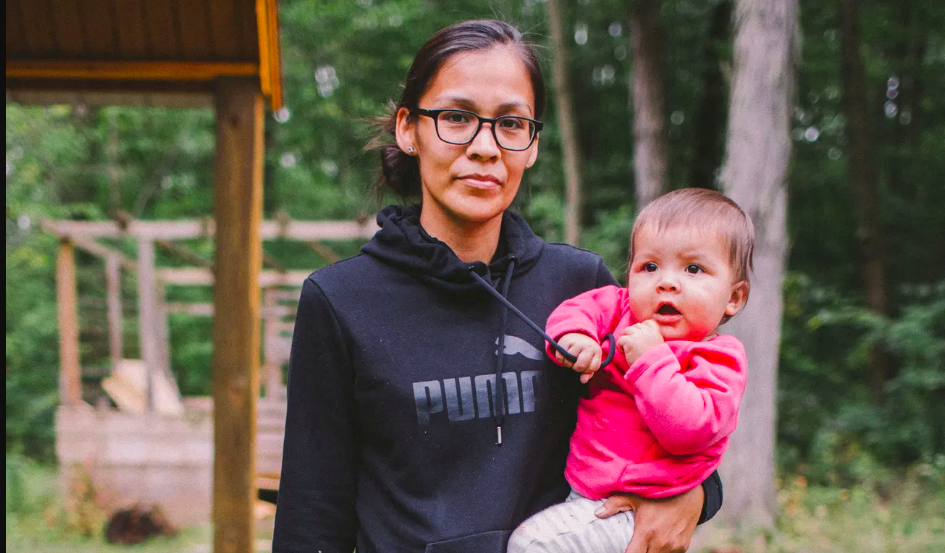
Photo from: https://www.theguardian.com/global/2018/oct/04/ontario-six-nations-nestle-running-water
(the photo was taken by Jennifer Roberts for The Guardian)
And on top of that, each bottle weights more than 40 pounds (19 kilos) so Thomas started to collect rainwater from the rooftop gutters. Unfortunately it wasn’t the best idea, since this led to the rash her son developed which was later diagnosed as impetigo. She believes the reason he got the rash in the first place was because of the bacteria that as on the roof shingles. The only thing is, water isn’t non-existent, it’s just inaccessible; some people have water in their taps but its too polluted to drink, while others just don’t have at all
Dawn Martin-Hill, a Six Nations local and professor of Indigenous Studies pointed out something. She asked, “Why do white people live with water and we don’t?” She added on that, “They don’t have to live like we live. There’s a lot of environmental racism.” According to Martin-Hill, the Six Nations locals didn’t approve of Nestle pumping water from their land, but the company ignored their requests and kept going.
JD Sault, another local, had paid several thousands of dollars so that she could be connected to the local well, but then found out the water was too polluted to drink, which is not only a waste of money, but I can’t imagine how upset she’d be. After spending all that money, you would think someone would help her find a solution. Someone like the Federal Government maybe? Unfortunately for the Six Nations, no. The Feds have actually done next to nothing to help out. “Nestlé are taking out water for free, so why don’t they dispense it to people?” Sault said
Legalties become apparent when acts like the Natural Resources Transfer Act of 1930 is brought up. The act basically says that provinces have the right to sell their water to whoever they want, including companies like Nestle, but in saying that the water is also supposed to be controlled by the Federal Government, who are responsible for the natural environment anyway. The uncertainty in this legal matter essentially made it easier for Nestle to keep going with the water extraction, for basically nothing. Nestle pays Ontario, but Six Nations get nothing, so Six Nations sued Ontario last year.
The temporary ban on new permits since 2016, ended up causing more problems, and the Ontario government gave the go ahead to pump water on expired permits until 2019, even though one of the permits expired in 2017.
Nestle was literally founded on the principle that spring water had health benefits, so in comparison to other companies like Dasani and Aquafina, the extraction of this spring water could take years and years to replenish, which doesn’t help the locals at all.
This ends up raising even more concerns, because according to the United Nations, by 2025, 1.8 billion people will live with water shortages, so companies like Nestle are trying to get as much of that water as possible. They’re looking out for themselves, but who’s looking out for the communities like Iokarenhtha Thomas’?
“The fact that Nestlé is commercializing these natural resources in a community that doesn’t have access to reliable safe, affordable drinking water is a stunning example of the disparities we see around the world in access to safe water,” Peter Gleick (the President of the Pacific Institute) said. “The rich can pay for water and the poor get shortchanged over and over again.”
I mentioned it before, everyone has their Nestlé favourites, but in this particular case, it seems that the company is doing more damage than good.
On the complete opposite end of the spectrum however, is Nestlé actually doing something right by extracting the water?
The water they’ve been extracting, is going towards some pretty great things. Nestlé recently began a partnership with not one but two large organisations, and pretty well-known ones at that. Nestlé’s partnership with Lego has had a positive impact on the children of the world.
The partnership entails Nestlé using Lego’s large platform, aimed at mostly children, to encourage staying hydrated. This in itself is actually a really good idea if you think about it. Lego is something that is so globally cherished by children and adults like. For a company who produces bottled water such as Nestlé to partner with Lego, the effect it’ll have on children will be massive. In this day and age, when children become so heavily influenced by what is shown to them on screens, the Lego industry becomes a prime example of why this partnership could thrive. The partnership is essentially exposing children to a new way of having fun while being healthy.
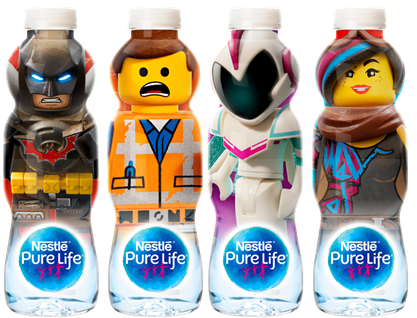
Photo from: https://www.talkingretail.com/products-news/soft-drinks/nestle-waters-partners-lego-get-children-drinking-water-04-03-2019/
Other than their partnership with Lego, Nestlé is also partnering with Box Tops for Education to get funding for education initiatives. Yumiko Clevenger-Lee, who is the Vice President & CMO of Nestlé Waters (North America.), said that, “Nestlé Pure Life’s partnership with Box Tops for Education is a natural extension of our support for families. We are proud to make choosing water a win-win for families who want to keep their children hydrated with a healthy beverage while supporting their local schools.”

With the assistance of a company as large as Nestle, this is a partnership that is a win-win – Nestle earns profits by helping out the Non-Profit Organisation and the Non-Profit benefits by having a large company help them in funding education, which is of course a right.
The real question still remains though. Even with the partnerships and all the wonderful things Nestlé have immersed themselves in, is it enough to forget that they’re essentially taking away a basic necessity from a small community?

 Ariba's Blog
